
Piano Transcription
A piano transcription is the process of converting a piece of music played on a piano (or another instrument) into a written format that can be read and understood by other musicians. This is typically done by hand using traditional sheet music or with the use of music notation software. Transcribing is a very useful skill for musicians to have because it allows them to take music they hear and turn it into something that can be played on a keyboard or performed live by a pianist.
It is important to note that getting from a musical passage to a written transcription in standard notation is incredibly difficult, especially when dealing with complex music with multiple instruments playing at once. As such, transcriptions should be considered a “rough draft” of a musical piece and should not be taken as an exact reproduction of the original performance.
The key to successful transcription is to start with what is easiest and work your way up to the harder parts. This will help you to develop your skills and eventually create a transcription that is as accurate as possible. The first step is to listen to the music and try to form a clear picture in your head of what the notes are supposed to be. It is very important to not play the piano while you are doing this and instead just focus on listening for the individual notes.
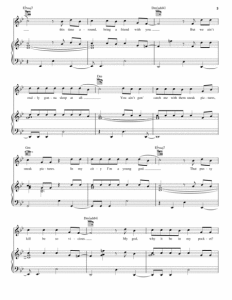
How is a Piano Transcription Notated?
Once you have a good picture of what the notes should be, it is time to look at the actual sheet music. The most common music notation is based on two staves, the treble and bass. The treble staff, which is typically marked with the G clef, notates higher pitch notes that are played with the right hand. The bass clef, which is typically marked with the F clef, notates lower pitch notes that are played with the left hand.
There are some other special symbols used in piano music notation that should be noted as well. These include rhythm dots which indicate that a note should be played for a duration that is half of its normal value, tie notes which are curved lines that connect two adjacent notes and tenuto which is a short line that indicates a note should be played slightly louder than usual.
Then there are the keys, sharps and flats which indicate what kind of tuning a song is in. For example, if a song has sharps then every note should be played as an F# even though the keyboard may display it as an F. This is because if a song has flats then all of the notes would be played as F, despite the fact that the keyboard may show them as Bb or C#.
If you are not familiar with all of the different music notation symbols it is helpful to learn them gradually over time. As with a jigsaw it is best to start with the easy parts and then move on to the more challenging ones.


+ There are no comments
Add yours